
Redirects
The Redirects section of Constructor dashboard is used to send users who enter a specific search term to a different page. This is useful when the result you want to display isn't part of your product catalog.
For instance, if a user types "order status," you could send them to an order status page.
How to configure redirects
Navigate to the Redirects section from the Constructor dashboard home page. You will see a list of all redirects configured.
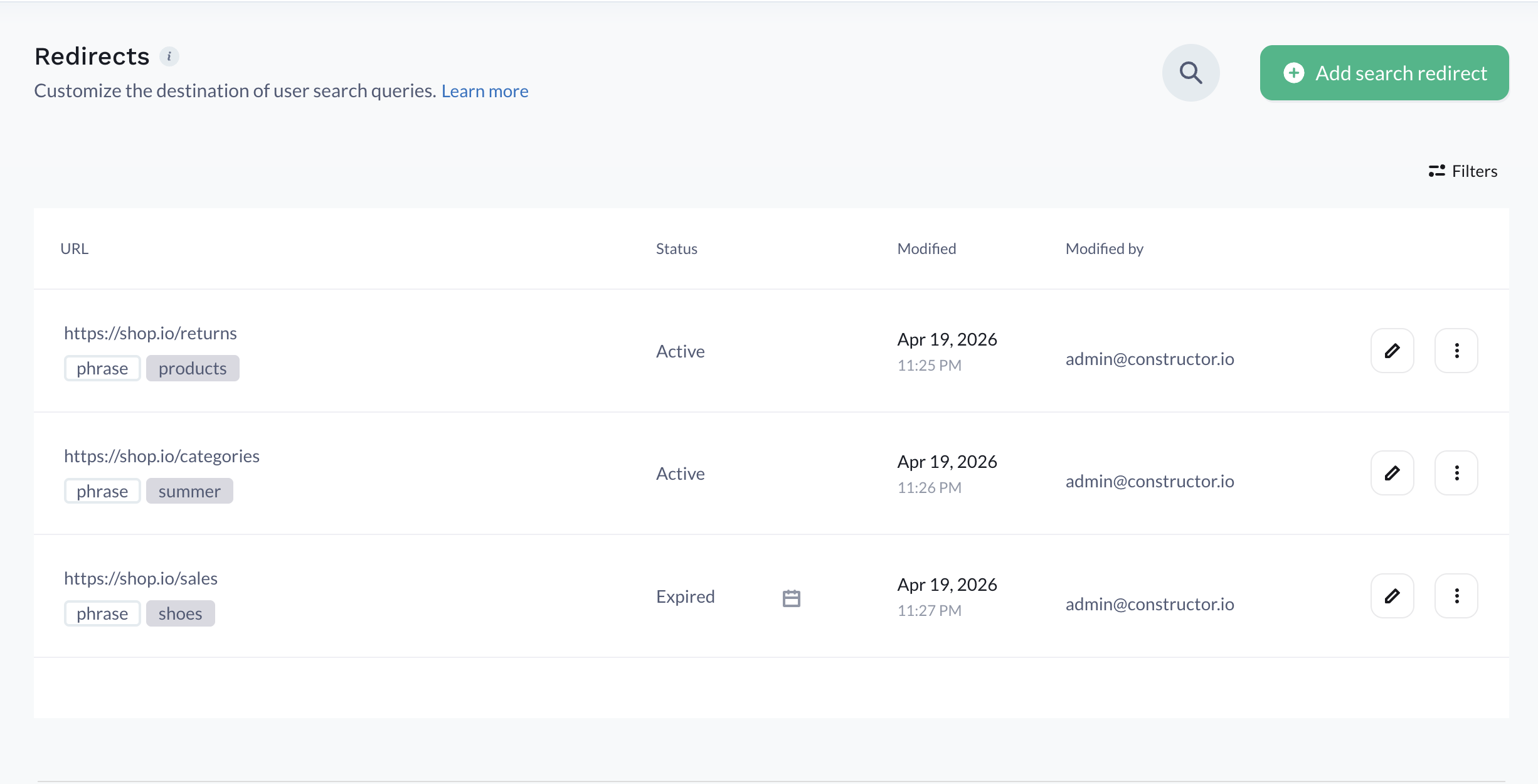
Configuring redirects via the Constructor dashboard
Select the Filters button to filter redirects by status: All, Active, Upcoming, or Expired.
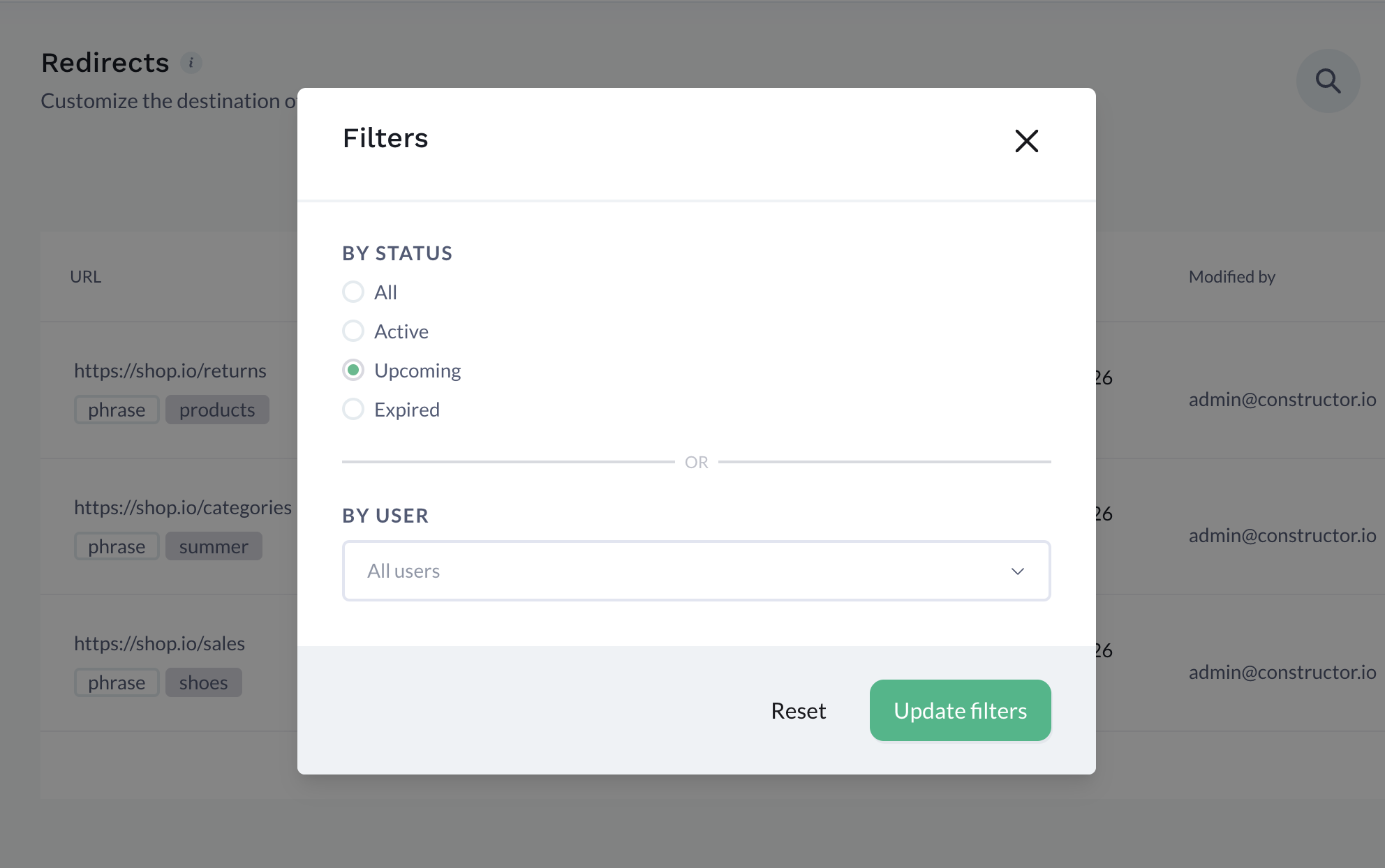
Filtering redirects via the Constructor dashboard
Create and manage redirect rules via APIYou also have the option to create and manage redirect rules via Constructor's API.
How to add redirects
Select the Add search redirect button, enter the redirect URL, select the matching criteria, and enter the relevant keywords.
Redirect types
There are three criteria you can use to specify when a redirect should be applied:
Phrase
For phrase matching, the exact phrase needs to be found somewhere in the user's search. For instance, enabling this criteria for the search query "return policy" would apply it when users search for "holiday returns policy," but not "policy for holiday returns."
Exact
For exact matching, all keywords need to match the user query exactly. For instance, enabling this criteria for the search query "returns" would apply it only on searches for "returns," and not "returns policy."
Unordered
For unordered matching, all keywords need to match the user query in any order. For instance, enabling this criteria for the search query "returns policy" would apply it for "policy returns," but not "holiday returns policy."
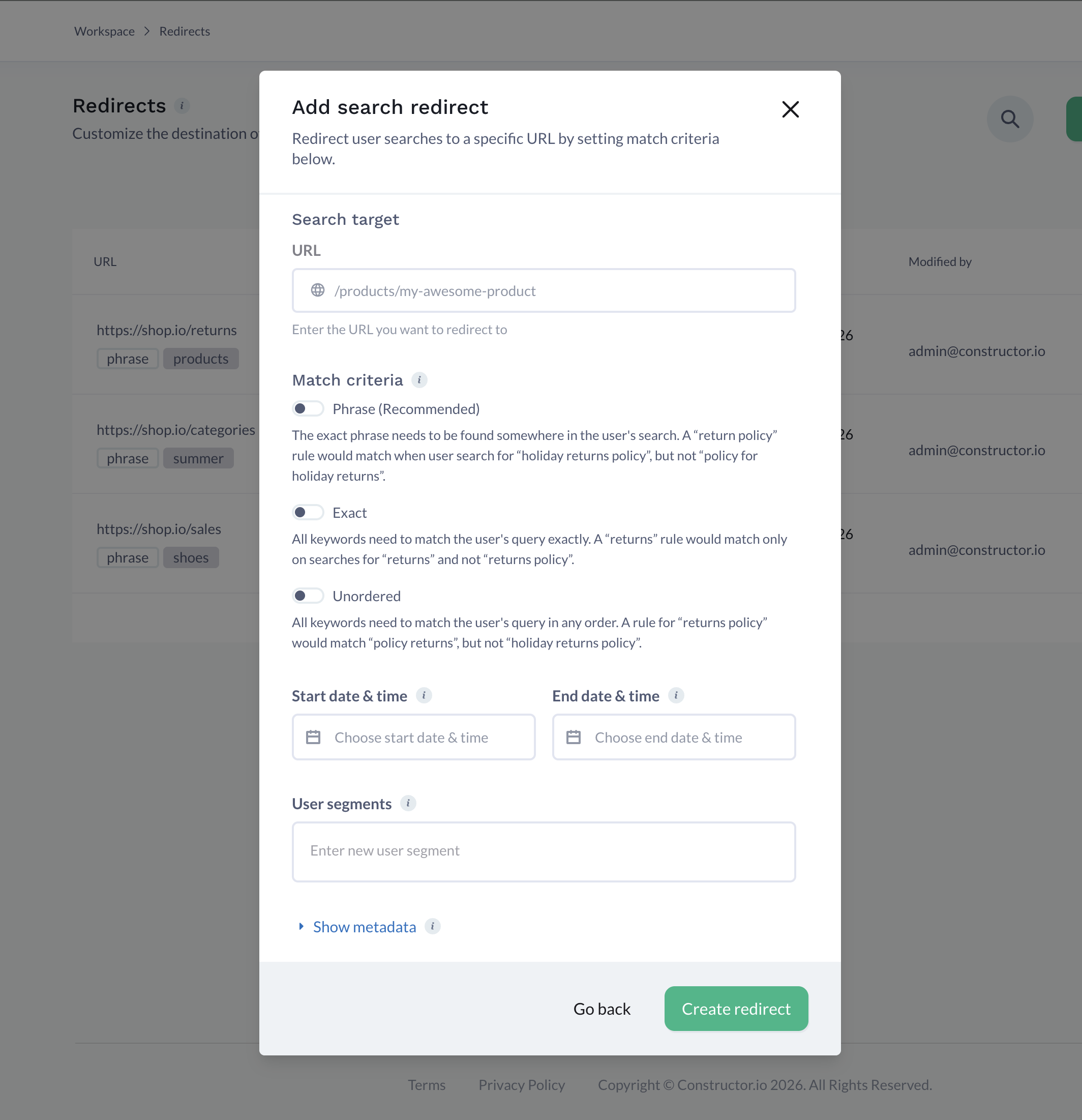
Adding a new search redirect via the Constructor dashboard
Add a start and end date, user segments, or metadata
You can optionally configure a start and end date, user segments, and metadata for a redirect. These options are available below the match criteria in the redirect editor.
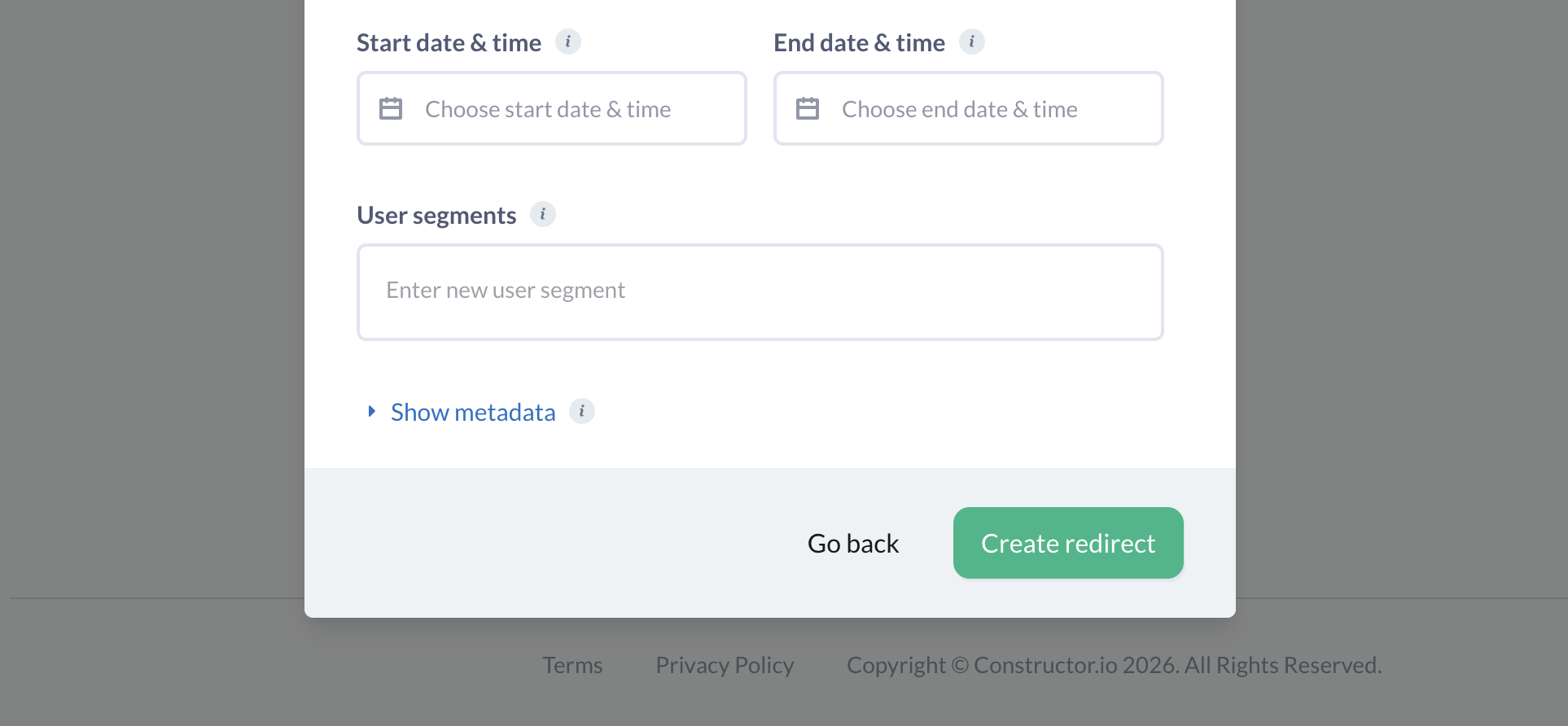
Configuring start and end dates, user segments, and metadata for a search redirect
Start and end date
You can add a Start Date and End Date to a redirect, which allows you to schedule when the redirect is active. Dates are optional. You can also define a start date without a set end date, or an end date without a start date.
- Select the Start date & time field to launch a date and time picker.
- Use the calendar picker to select the specific start date for the redirect.
- Use the time fields to select the specific start time, including hour, minute, and AM/PM.
- Select the End date & time field to launch a date and time picker.
- Use the calendar picker to select the specific end date for the redirect.
- Use the time fields to select the specific end time, including hour, minute, and AM/PM.
- The end date and time must be after the start date and time.
Based on the dates configured, the redirect will display one of the following statuses on the redirects list page:
- Active: The redirect is currently in effect. This is the default status when no dates are set, or the current time falls between the start and end dates.
- Upcoming: The redirect has a start date in the future. It will automatically become active when the start date is reached.
- Expired: The redirect has an end date in the past and is no longer active.
User segments
You can target a redirect to specific user segments. When user segments are applied, only users who belong to all of the listed segments will be redirected.
- In the User segments field, enter the name of a segment or select from the dropdown.
- The dropdown displays segments observed in the last 7 days, sorted by the number of requests.
- You can add multiple segments by entering each one separately.
- To remove a segment, select the x on the segment tag.
Passing user segmentsTo utilize this feature, you'll need to pass users' segments from the front-end using the
usparameter.
Metadata
You can add custom metadata (in JSON format) to return along with a redirect rule match. Use this to deliver mobile app content or facilitate tracking.
- Select Show metadata to expand the metadata editor.
- Enter a valid JSON object in the editor. For example:
{ "campaign_id": "summer_sale", "app_screen": "promotions" }- The metadata must be a valid, non-empty JSON object.
After saving, metadata is indicated by a metadata icon on the redirects list. Select the icon to view the full metadata in a side panel.
Save the redirect
Select Create redirect to save the new redirect, or Save changes if editing an existing redirect.
Implementing redirectsCreating a redirect will include the target URL in Constructor's search response. It is up to your development team to initiate the redirect to the target page.
Updated 5 months ago